


Fevereiro 11, 2016 / Hospital de Treinamento e Pesquisa Konya / Dermatologic Therapy
Texto/Wu Tingyao
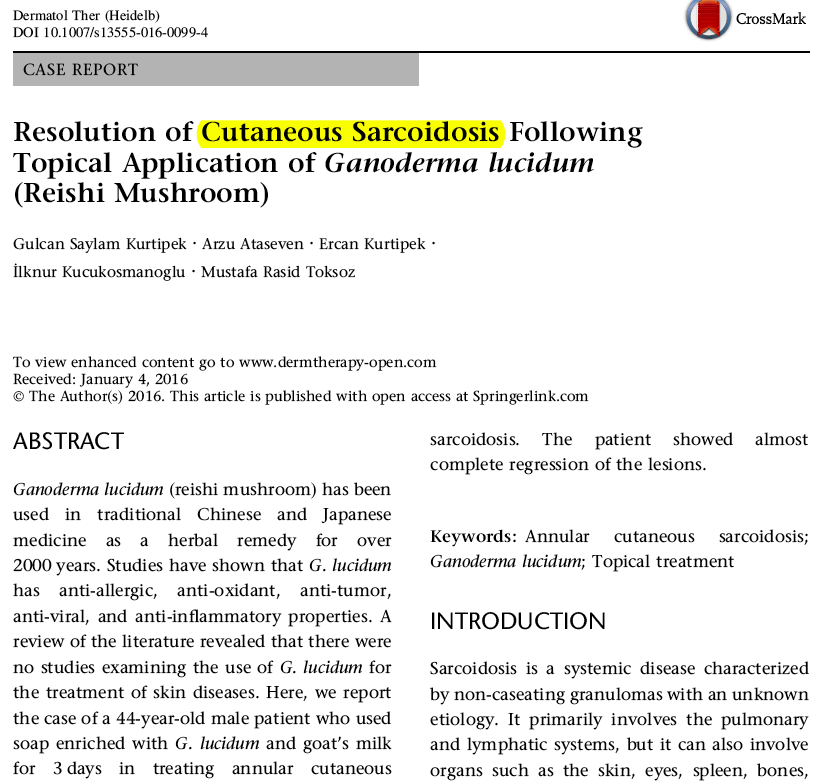
Em fevereiro 2016, a report published by the Turkish Konya Training and Research Hospital in Dermatologic Therapy pointed out that the application of the medicated soap containing Ganoderma lucidum for a week helped a patient in a dermatology clinic improve the sarcoidosis of the scalp. This case showed the possibility of Ganoderma lucidum being applied to skin diseases. Whether the Ganoderma lucidum soap only for external use has this effect needs to be further clarified.
Sarcoidosis is an inflammatory disease in which granulomas, or clumps of inflammatory cells, form in various organs. This causes organ inflammation. Many inflammatory cells (including macrophages, epithelioid cells and multinucleated giant cells derived from macrophages) gather in a granuloma. A single granuloma is so small that it can only be seen under a microscope. As it gathers more and more, it will form large and small lumps that are visible to the naked eye.
Sarcoidosis can occur in any part of the body, especially in the lungs and lymphatic system. It also appears on the skin of one-third of patients. People who get this disease usually do not have symptoms in only one tissue or organ. The affected part may be painful, itchy, or scarred by ulcers, and it may also affect organ function.
Although the pathogenesis of sarcoidosis is not fully understood, immune factors are involved in the pathogenesis of sarcoidosis. Portanto, steroids, anti-inflammatory drugs or other immunosuppressants are usually used for treatment. Some people’s granulomas may shrink or disappear. Some people’s granulomas are always there, and the condition may change from time to time. Some people will have scars on the affected area and their organs will suffer permanent damage.
A report issued by this Turkish hospital stated that a 44-year-old man with sarcoidosis improved his skin symptoms by using medical soap containing Ganoderma lucidum. A dermatological examination showed that the patient’s skin had multiple plaque lesions of annular erythema with central atrophy and raised borders. After the tissue biopsy, the patient’s lesion inflammation and granuloma penetrated deep into the dermal tissue.
Inicialmente, he only had skin symptoms. Mais tarde, he was diagnosed with “bilateral hilar lymphadenopathy”, which is a typical symptom of pulmonary sarcoidosis in patients. After a period of regular treatment, the patient continued to return to the hospital to track his condition. During this follow-up visit, the patient stated that Ganoderma lucidum seemed to be helpful for the sarcoidosis on his scalp:
He applied medicated soap containing Ganoderma lucidum to the affected area every day, kept the soap foam on the lesion for 1 h, and then rinsed it. Three days later, those red lumps almost all subsided. Six months later, the lesion on the scalp recurred again, and he treated it with Ganoderma lucidum soap in the same way. The symptoms were relieved within a week.
The personal experience of this patient gave us an insight into the alternative applications of Ganoderma lucidum. No passado, many studies have confirmed that oral administration of Ganoderma lucidum can exert anti-allergic, anti-oxidant and anti-inflammatory effects, but why does Ganoderma lucidum medicated soap for external use work? This needs to be further clarified.
[Fonte] Saylam Kurtipek G, et al. Resolution of cutaneous sarcoidosis following topical application of Ganoderma lucidum (Reishi Cogumelo). Dermatol Ther (Heidelb). 2016 Fevereiro 11.
FIM
Sobre o autor/ ms. Wu Tingyao
Wu Tingyao tem relatado informações em primeira mão sobre Ganoderma desde 1999. Ela é autora de Cura com Ganoderma (Publicado na editora médica do povo em abril 2017).
★ Este artigo é publicado sob a autorização exclusiva do autor.
★ As obras acima não podem ser reproduzidas, extraído ou usado de outras formas sem a autorização do autor.
★ Violação da declaração acima, o autor exercerá suas responsabilidades legais relacionadas.
★ O texto original deste artigo foi escrito em chinês por Wu Tingyao e traduzido para o inglês por Alfred Liu. Se houver alguma discrepância entre a tradução (Inglês) e o original (chinês), o chinês original prevalecerá. Se os leitores tiverem alguma dúvida, entre em contato com o autor original, EM. Wu Tingyao.


