


August 26, 2015 / Universidad de Kyushu / Informes Científicos
Texto/Wu Tingyao
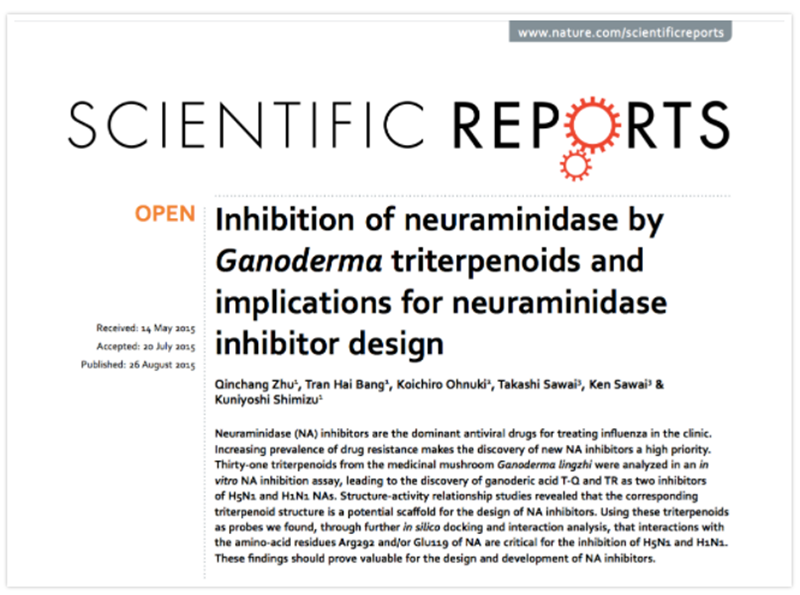
El equipo de investigación de Kuniyoshi Shimizu., profesor asociado en el Instituto de Ciencias Agrícolas de la Universidad de Kyushu en Japón, confirmó que 31 Los triterpenoides aislados del cuerpo fructífero de Ganoderma inhiben la neuraminidasa de cinco virus de la influenza A en diversos grados., entre los cuales hay dos triterpenoides incluso aptos para el desarrollo como fármacos antigripales. Los resultados de la investigación se publicaron a finales de agosto en "Scientific Reports" del grupo editorial "Nature". 2015.
La neuraminidasa es una de las dos proteínas que sobresalen de la superficie de los virus de la influenza A. Cada virus de la gripe tiene alrededor de cien de estas proteasas.. Cuando el virus invade la célula y utiliza el material de la célula para replicar nuevas partículas de virus., La neuraminidasa es necesaria para que las nuevas partículas del virus se separen de la célula e infecten aún más otras células.. Por lo tanto, cuando la neuraminidasa pierde su actividad, el nuevo virus quedará encerrado en la celda y no podrá escapar, la amenaza al anfitrión se reducirá, y la enfermedad se puede controlar. El oseltamivir de uso común (tamiflú) en la práctica clínica es utilizar este principio para prevenir la proliferación y propagación del virus..
Según una investigación realizada por Kuniyoshi Shimizu, a una concentración de 200 µM, Estos triterpenoides de Ganoderma inhibieron la actividad del H1N1., H5N1, H7N9 y dos cepas mutantes resistentes NA (H1N1, N295S) y NA (H3N2, E119V) en diversos grados. En general, el efecto inhibidor sobre la neuraminidasa de tipo N1 (especialmente H5N1) es el mejor, y el efecto inhibidor sobre la neuraminidasa del H7N9 es el peor. Entre estos triterpenoides, El ácido ganodérico TQ y el ácido ganodérico TR mostraron los niveles más altos de inhibición., y los efectos de estos dos compuestos variaron desde 55.4% a 96.5% inhibición para diferentes subtipos de NA.
Un análisis más detallado de la relación estructura-actividad de estos triterpenoides reveló que los triterpenoides, que tienen un mejor efecto inhibidor sobre la neuraminidasa N1, tienen la estructura principal de “triterpenoides tetracíclicos con dos dobles enlaces, una rama como grupo carboxílico, y un grupo que contiene oxígeno en el sitio R5” (Backbone A en la siguiente figura). Si la estructura principal son las otras dos (Backbone B y C en la siguiente figura), el efecto será pobre.
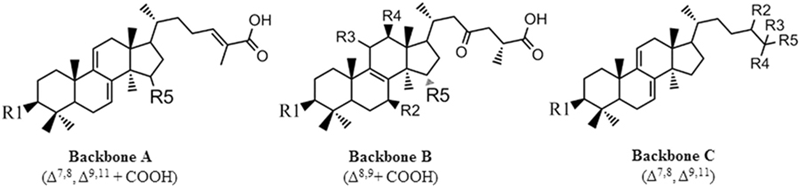
(Fuente/Representante científico. 2015 Ago 26;5:13194.)
El acoplamiento in silico se utiliza para simular la interacción de los ácidos ganodéricos. (TQ y TR) y neuraminidasas (H1N1 y H5N1). Como resultado, Se descubrió que tanto los ácidos ganodéricos como el Tamiflu podían unirse directamente al área activa de la neuraminidasa.. Esta área activa está compuesta por varios residuos de aminoácidos.. Los ácidos de Ganoderma TQ y TR se unirán a los dos residuos de aminoácidos Arg292 y Glu119.. Tamiflu tiene otra opción, pero también puede hacer que la neuraminidasa sea ineficaz.
En comparación con la inhibición de otras proteínas del virus de la influenza (como la proteína M2, que abre la cubierta del virus en el momento en que el virus se une a la célula huésped y envía los genes virales a la célula), Los inhibidores de la neuraminidasa se reconocen actualmente como fármacos eficaces y menos resistentes para el tratamiento de la gripe.. Por lo tanto, Los investigadores creen que los ácidos ganodéricos T-Q y TR, que son similares pero no iguales en el mecanismo de Tamiflu, tener la oportunidad de ser utilizado como una nueva generación de medicamentos contra la influenza o referencias de diseño.
Sin embargo, existe un requisito previo para que el medicamento se utilice como medicamento contra la influenza, eso es, el medicamento debe inhibir eficazmente la reproducción del virus sin dañar las células infectadas por el virus.. Sin embargo, en experimentos con células infectadas con virus vivos y líneas celulares de cáncer de mama (MCF-7), Se descubrió que cuando los investigadores utilizaron estos dos tipos de ácidos ganodéricos solos., tenían dudas sobre la alta citotoxicidad, pero también encontraron otro tipo de triterpenoide de Ganoderma, ganoderol B, tiene un efecto inhibidor sobre el H5N1 (pero el efecto inhibidor es pobre), pero no es citotóxico. Por lo tanto, Los investigadores creen que se debe considerar cuidadosamente cómo mejorar la seguridad de los ácidos ganodéricos T-Q y TR mediante la modificación de la estructura química y al mismo tiempo conservar su inhibición de la actividad de la neuraminidasa..
[Fuente] ZhuQ, et al. Inhibición de la neuraminidasa por los triterpenoides de Ganoderma e implicaciones para el diseño del inhibidor de la neuraminidasa. Representante de ciencia. 2015 Ago 26;5:13194. doi: 10.1038/srep13194.
FIN
Sobre el autor/ ms. Wu Tingyao
Wu Tingyao ha estado brindando información de primera mano sobre Ganoderma desde 1999. Ella es la autora de Curación con ganoderma (Publicado en People’s Medical Publishing House en abril 2017).
★ Este artículo se publica bajo la autorización exclusiva del autor.
★ Los trabajos anteriores no se pueden reproducir, extraído o utilizado de otras maneras sin la autorización del autor.
★ Por violaciones de la declaración anterior, el autor perseguirá las responsabilidades legales pertinentes.
★ El texto original de este artículo fue escrito en chino por Wu Tingyao y traducido al inglés por Alfred Liu. Si hay alguna discrepancia entre la traducción (Inglés) y el original (Chino), El chino original prevalecerá. Si los lectores tienen alguna pregunta, Póngase en contacto con el autor original, EM. Wu Tingyao.


