


El equipo dirigido por el profesor Yang Baoxue, director del departamento de farmacología, Facultad de Ciencias Médicas Básicas de la Universidad de Pekín, publicó dos artículos en el “Acta Pharmacologica Sinica” a finales de 2019 y temprano 2020, confirmando que el ácido ganodérico A, as the main active ingredient ofGanoderma lucidum, has the effect on delaying renal fibrosis and polycystic kidney disease.
Ganoderic A retarded the progression of renal fibrosis
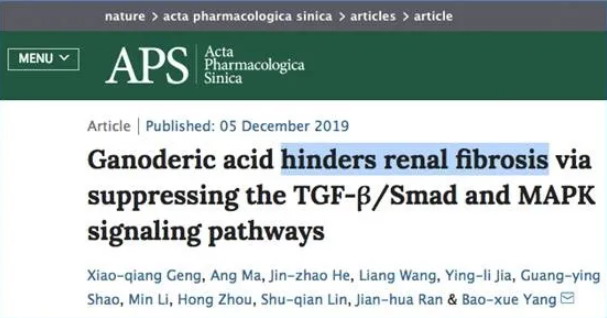
The researchers surgically ligated unilateral ureters of the mice. Después 14 días, the mice developed kidney tubules damage and kidney fibrosis due to blocked urine excretion. Mientras tanto, the elevated blood urea nitrogen (BOLLO) y creatinina (cr) indicated the impairment of kidney function.
Sin embargo, if the mice were given an intraperitoneal injection of ganoderic acid at a daily dose of 50 mg/kg immediately after unilateral ureteral ligation, the degree of kidney tubules damage, renal fibrosis or renal function impairment after 14 days was significantly less than in mice without Ganoderma protection.
The ganoderic acid used in the experiment was a mixture containing at least a dozen different kinds of ganoderic acids, of which the most abundant were ganoderic acid A (16.1%), ácido ganodérico B (10.6%) and ganoderic acid C2 (5.4%).
In vitro cell experiments showed that ganoderic acid A (100µg/mL) had the best inhibitory effect on renal fibrosis among the three, even had a better effect than the original ganoderic acid mixture and had no toxic effect on renal cells. Por lo tanto, the researchers believed that ganoderic acid A should be the main source of activity ofHongo reishi in delaying renal fibrosis.
Ganoderic acid A retards the progression of polycystic kidney disease
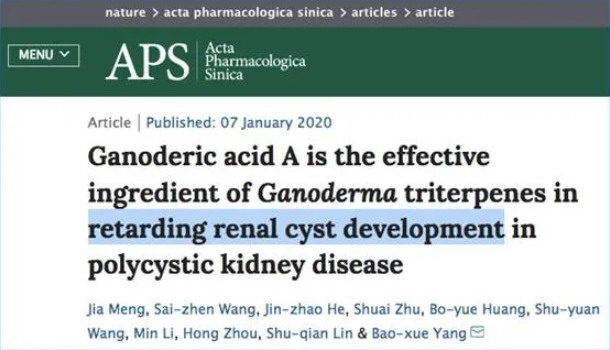
Unlike the etiological factor of renal fibrosis, polycystic kidney disease is caused by a mutation in a gene on the chromosome. Ninety percent of the disease is inherited and usually begins around the age of forty. The vesicles of the kidneys of the patient will grow larger as time goes on, which will squeeze and destroy normal kidney tissue and damage kidney function.
In the face of this irreversible disease, delaying the deterioration of renal function has become the most important therapeutic goal. Yang’s team published a report in the medical journal named Kidney International at the end of 2017, confirming that Ganoderma lucidum triterpenes have the effect of delaying the onset of polycystic kidney disease and alleviating the syndrome of polycystic Kidney disease.
Sin embargo, there are many types ofLingzhi triterpenos. Which type of triterpene plays a key role in this? In order to find out the answer, they tested various Ganoderma triterpenes including ganoderic acid A, B, C2, D, F, GRAMO, T, DM and ganoderenic acid A, B, D, F.
In vitro experiments showed that none of the 12 triterpenes affected the survival of kidney cells, and the safety was almost at the same level, but there were significant differences in inhibiting the growth of renal vesicles, among which the triterpene with the best effect was ganoderic acid A.
From the development of renal fibrosis to renal failure, it can be said that it is the result of a variety of causes (como la diabetes).
Para pacientes con enfermedad renal poliquística, the rate of decline in renal function may be faster. Según las estadísticas, about half of patients with polycystic kidney disease will deteriorate to renal failure around the age of 60, and they must receive kidney dialysis for life.
Professor Yang Baoxue’s team has passed cell and animal experiments to prove that ganoderic acid A, the highest proportion of Ganoderma triterpenes, is an index component of Ganoderma lucidum for kidney protection.
Por supuesto, this is not to say that only ganoderic acid A in Ganoderma lucidum can protect the kidneys. De hecho, other ingredients are certainly of help. Por ejemplo, another paper published by Professor Yang Baoxue on the topic of kidney protection also pointed out that Ganoderma lucidum polysaccharide extract can reduce the oxidative damage received by kidney tissue through the antioxidant effect.Ganoderma lucidum triterpenoids, which contains various triterpene compounds such as ganoderic acid, ganoderenic acid and ganederol work together to delay renal fibrosis and polycystic kidney disease.
¿Qué es más?, the need to protect the kidney is not just for protecting the kidney itself. Others such as regulating immunity, improving three highs, equilibrio endocrino, soothing the nerves and improving sleep will certainly help kidney protection, which cannot be realized only through ganoderic acid A.
Ganoderma lucidum is distinguished by its various ingredients and functions, which can coordinate with each other to find the best balance for the body. Es decir, for kidney protection, if Ganoderic acid A is missing, the effectiveness of Ganoderma triterpenes will be obviously reduced.

[Referencias]
1. xq, et al. El ácido ganodérico dificulta la fibrosis renal mediante la supresión de las vías de señalización de TGF-β/Smad y MAPK.. Acta Pharmacol Pecado. 2019 Dic 5. doi: 10.1038/s41401-019-0324-7.
2. Meng J., et al. Ganoderic acid A is the effective ingredient of Ganoderma triterpenes in retarding renal cyst development in polycystic kidney disease.Acta Pharmacol Sin. 2020 Ene 7. doi: 10.1038/s41401-019-0329-2.
3. en el, et al. Ganoderma triterpenes retard renal cyst development by downregulating Ras/MAPK signaling and promoting cell differentiation. Riñón Int. 2017 Dic; 92(6):1404-1418. doi: 10.1016/j.salida.04.013.2017.
4. ZhongD, et al. Ganoderma lucidum polysaccharide peptide prevents renal ischemia reperfusion injury via counteracting oxidative stress.Sci Rep. 2015 Nov 25; 5:16910. doi: 10.1038/srep16910.
★ Este artículo se publica bajo la autorización exclusiva del autor, and the ownership belongs to GanoHerb ★ The above works cannot be reproduced, excerpted or used in other ways without the authorization of GanoHerb ★ If the works have been authorized to be used, Deben usarse dentro del alcance de la autorización e indicar la fuente: GanoHerb ★ Violation of the above statement, Ganoherb perseguirá sus responsabilidades legales relacionadas.


